24
Wing
feathers
A bird’s wing feathers (remiges) combine strength
with lightness and flexibility. Compared with the rest
of the body, the wings have relatively few feathers.
Together, they form a perfect surface for flight.
The outer
wing
Outer wing feathers
provide most of the
power for flight and
prevent a bird from
“stalling”. The outermost
flight feathers can be
spread open or closed
up, to help with steering.
Barn
owl
Green
woodpecker
Jay
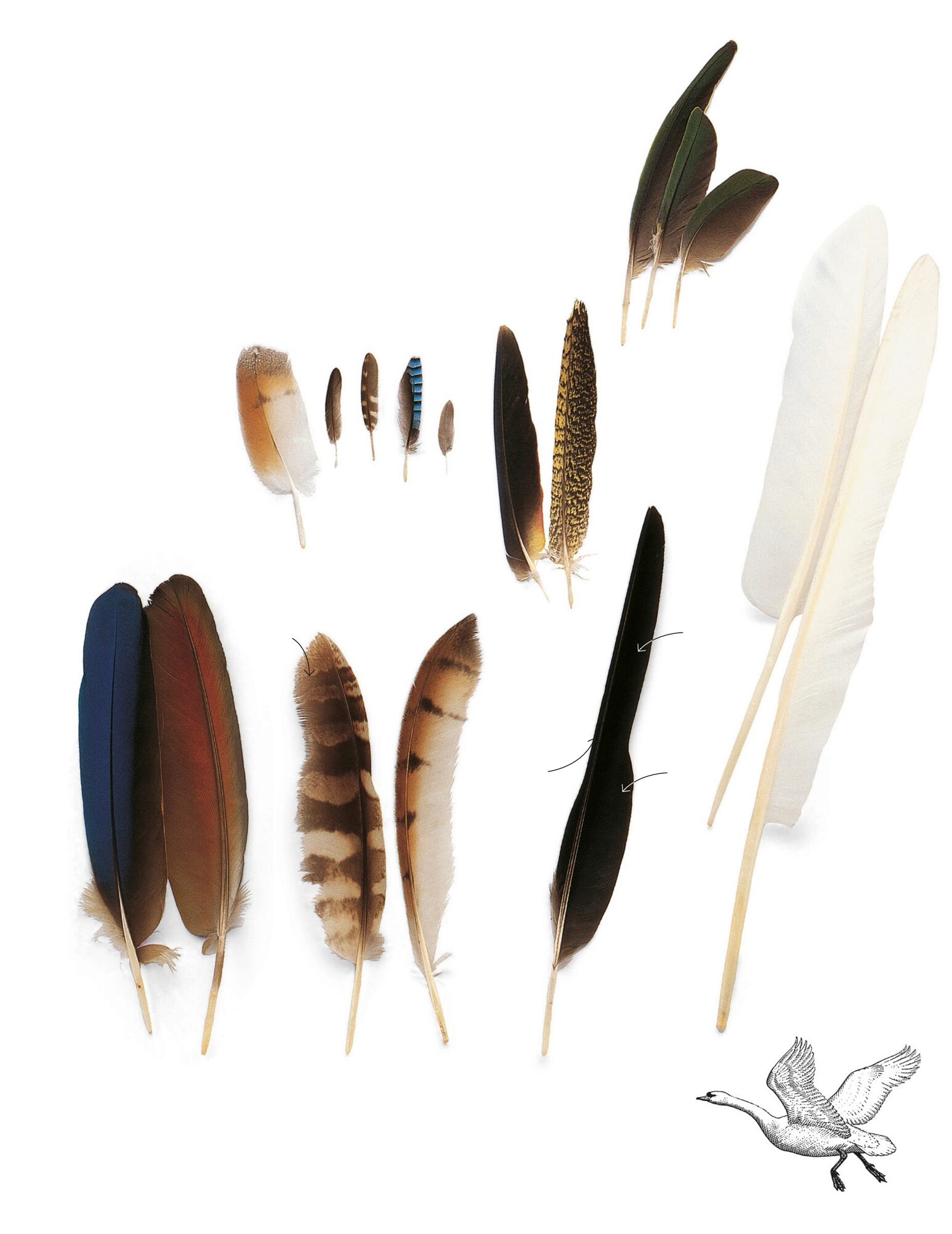
Lopsided
Most flight feathers
are narrower on the
leading edge to
provide lift.
Slotted feathers
The deep slot in
this crow’s feather
reduces turbulence.
Coverts
By overlapping the bases
of the flight feathers, the
coverts smooth the flow
of air.
Wider
trailing
edge
Slot
Narrow
leading
edge
Fringe
Barn
owl
Graded shapes
Away from the wing
tip, the feathers are
shorter and broader.
Swan
Silent feathers
The fringed edges
of owl feathers help
to make flight silent.
Above and below
Many wing feathers, such as
these macaw feathers, have
different structures on the
upper surface, which makes
it produce different colours.
Tawny owl
Adult
starling
Young
starling
Heavy-duty
feathers
The mute swan,
which weighs up to
12 kg (26 lb), needs
long, strong feathers
to power its flight.
Macaw